


Dog Lifespan: 5 Factors That Truly Matter
A dog's lifespan can double or halve depending on size, genetics and daily care. Here are the 5 factors that make the real difference to how long your dog lives.
A Chihuahua often passes 15 years. A Great Dane rarely reaches 10. Everything in between is decided along the way.
Some factors are set at birth. Others come down to you, every day. And those are exactly the ones that matter most.
Adult Size: Decided Before Birth
Adult size remains the strongest predictor of longevity we have. Researchers confirm it study after study, across millions of veterinary records. Before diet, before medical care, size draws the first line. Here is what the numbers actually say.
• Average Lifespan by Weight Class
The benchmarks fit into four lines. Under 33 pounds, a dog averages 12 to 16 years. Between 33 and 100 pounds, expect 10 to 13 years. Above 100 pounds, the range drops to 8 to 12 years. Giant breeds rarely pass 10 years. That is a six year spread from one end of the scale to the other.
A 2022 Royal Veterinary College study reviewed more than 13 million UK veterinary records. It puts the median at 12.7 years across all sizes. That single number hides the real story, because how long a dog lives depends first on adult weight. A Chihuahua can reach 18 years. A Bulldog often stops around 7. Same species, two very different timelines. The rule holds: the smaller the dog, the longer the life.
• Why Large Breeds Age Faster
Biology explains it clearly. A giant breed puppy multiplies its birth weight roughly one hundred times in two years. A small breed reaches full size in fifteen months, with a far smaller jump. That rapid growth pushes cells to divide at an intense pace. More divisions mean more chances for errors. Researchers see this as the leading explanation for the high cancer rates in large breeds.
Work by Cornelia Kraus at the University of Göttingen links growth speed directly to faster aging. The practical impact is immediate. A Great Dane counts as senior around age 7. A terrier gets there around age 11. Your care calendar therefore shifts with size. Watching the joints, adjusting exercise and protecting your dog's daily well being becomes a priority far earlier in large breeds.
• Purebred vs. Mixed Breed: The Real Gap
You hear it everywhere: mixed breeds are tougher than purebreds. Hybrid vigor is a real genetic effect, yet recent data complicates that shortcut. A 2024 Scientific Reports study covering 584,000 UK dogs actually favors purebreds, at 12.7 years against 12 years for crossbreeds. The finding runs against the popular view.
Other research leans the opposite way, giving mixed breeds roughly one extra year. The Dog Aging Project, meanwhile, finds no meaningful difference at all. The honest takeaway fits in one sentence: size matters far more than pedigree status.
A small purebred will outlive a large mixed breed almost every time. To understand what crossbreeding really delivers, read our analysis of hybrid dog health.

What the Breed Passes Down
A breed is more than a look. Every line carries its own genetic package, with real strengths and real weak spots. Some of those weak spots cut years off a dog's life. Veterinary data now lets us name them, and often get ahead of them.
• The Most Common Inherited Conditions
Every breed carries its own set of risks. Hip dysplasia hits German Shepherds and Labradors hard. Dobermans pay a heavy price for dilated cardiomyopathy. Cavalier King Charles Spaniels face both valve disease and syringomyelia. Bernese Mountain Dogs post one of the highest cancer rates of any breed. None of this is bad luck, it follows bloodlines.
These conditions share a schedule. They usually surface between ages 5 and 8, right in the middle of adulthood, and cut several years off the timeline. Early screening genuinely changes outcomes in many cases, as long as you know your breed's specific risks. One reassurance: these diseases stay strictly canine.
To separate myth from fact on what your dog can actually pass to you, read our investigation into diseases dogs can pass to humans.
• Flat Faces and Long Backs: Built-In Risks
Two body shapes draw most of the veterinary concern. A 2024 Dogs Trust study of 584,000 dogs gives flat faced breeds a 40 percent higher risk of early death. French Bulldogs post a median of 9.8 years there, against 13.1 years for Border Collies. That works out to a year and a half of lost life across brachycephalic breeds as a whole.
The number shifts a lot depending on method. Royal Veterinary College life tables drop to 4.5 years for that same breed, a disputed figure that mostly reflects poorly selected lines and a very young population sample. Long backs follow the same pattern.
Dachshunds carry a disc herniation risk 10 to 12 times higher than other breeds, with 15 to 24 percent affected during their lifetime. Breeding toward open nostrils and shorter backs is already reversing the trend among committed breeders.
• What DNA Testing Can Catch Early
Veterinary panels now screen more than 200 mutations for around a hundred dollars. They reliably flag single gene conditions such as progressive retinal atrophy, MDR1 drug sensitivity and degenerative myelopathy. One test before breeding prevents entire litters at risk. Serious breeders now publish these results without waiting to be asked.
The method has clear limits. A carrier will never develop the disease itself, it can only pass the variant along. Plenty of owners confuse the two statuses and worry for nothing. There is a second blind spot too. Dysplasia, epilepsy and most cancers involve dozens of genes, well beyond what current panels detect.
Radiographic screening and regular veterinary checks keep their full value. A DNA panel adds to the clinical exam, it never replaces it.

Body Weight and Diet
This is the one factor you control completely. A fourteen year study measured its impact with unusual precision. The result goes well beyond what most owners expect. And it costs nothing to apply. You need a scale and a bit of consistency, nothing more.
• Extra Pounds, Fewer Years
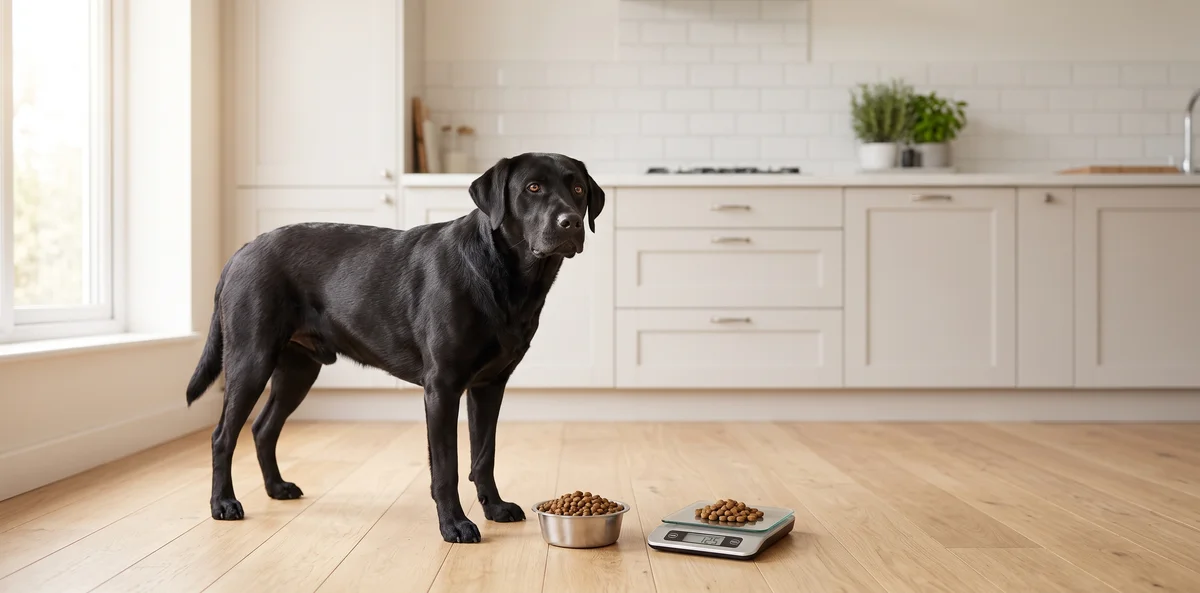
In 1987, Purina began tracking 48 Labradors from seven litters. Researchers paired up littermates. One dog ate freely, the other got 25% less food. The protocol ran fourteen years, until the last dog died. The verdict: a median of 13 years for the lean fed group against 11.2 years for the controls. That is 1.8 extra years, from portion size alone.
The gain went past raw longevity. Lean dogs needed their first treatment for a chronic condition at age 12, compared with 9.9 years for the others. By age two, they already showed half as many cases of hip dysplasia, and milder ones.
Our guide to canine hip dysplasia breaks down that mechanism. One caveat worth keeping: the sample was small and covered a single breed.
• What a Lean Dog Actually Looks Like
Forget the scale for a moment. Vets use a visual grid scored from 1 to 9, the Body Condition Score. The target sits between 4 and 5. Three checks let you assess your own dog.
You feel the ribs under light pressure, without pressing. From above, the waist tucks in clearly behind the ribs. From the side, the belly rises toward the back legs. All three present means your dog sits at a healthy weight.
Our eyes are the real obstacle. Veterinary surveys show most owners place an overweight dog in the normal category. Daily familiarity quietly shifts the baseline.
One simple habit fixes it. Photograph your dog from above and from the side every three months, always in the same spot. Comparing the shots shows what your eye stopped noticing. Weigh him monthly too, on the same scale.
• Portion Control: The Only Proven Method
One approach holds up over time: measuring the food. Put the measuring cup away and use a digital kitchen scale. The gap between a packed cup and a level one easily reaches 30%.
Feeding charts printed on the bag aim high as well, often 10% to 20% above actual need. Treat them as a starting point, never as an instruction.
Treats carry more weight than owners think. Vets recommend capping them at 10% of daily calories. The rest comes down to routine. Adjust portions in 10% steps, weigh the dog every two weeks, and give each change three weeks before you judge it. Exercise alone never slims a dog down. It protects muscle while the portion size does the actual work.
Preventive Veterinary Care
Three appointments a year, a few habits at home, and the trajectory shifts. Prevention costs little next to the treatments it avoids. What it really demands is consistency. Here is what the data actually shows, including on the topics vets still argue about.
• Vaccines, Parasites, and Teeth
Core vaccines cover distemper, hepatitis, parvovirus and rabies. Boosters follow a yearly or three year schedule depending on the component. With parasites, geography calls the shots. Heartworm dominates across the southern states, while ticks carry Lyme disease and anaplasmosis further north. Year round preventives remain the only approach that reliably works.
The mouth stays the blind spot. Studies estimate 80% of dogs show periodontal disease past age three. Yet UK primary care records log diagnoses in just 12.5% of cases. That gap measures exactly what slips through unnoticed.
Oral bacteria travel to the heart, the kidneys and the liver. Brushing three times a week, plus a professional cleaning when your vet recommends one, breaks the cycle before it costs anything serious.
• Spaying and Neutering: What the Studies Show
This topic splits opinion, and the numbers explain why. The 2013 Hoffman study, covering 40,139 US records, found an average age at death of 9.4 years for sterilized dogs against 7.9 years for intact ones. The gap looks decisive. What it really shows is a shift in causes of death, not a simple extension of life.
Sterilized dogs die more often from cancer and autoimmune disease. Intact dogs succumb more often to trauma, roaming and infection. Hart's work on Golden Retrievers adds a serious caveat: neutering before six months doubles hip dysplasia rates in males.
The same timing applied to Labradors shows almost no effect at all. Breed and timing matter far more than the decision itself. Talk the schedule through with your vet rather than defaulting to six months.
• When Senior Screening Should Begin
Old age arrives by size, not by the calendar. A Great Dane counts as senior around 7. A Labrador around 8. A Cocker Spaniel around 10. A Jack Russell around 11. Past that point, visits go from once to twice a year. Vets add bloodwork, a urinalysis and a blood pressure reading to the standard exam.
The value of screening comes down to one fact. Chronic kidney disease produces visible symptoms only after two thirds of kidney function is gone. A blood panel catches it months earlier.
The same holds for hypothyroidism, diabetes and abdominal masses. Those extra months often change the outcome entirely. Weigh your dog at every visit too, since unexplained weight loss is usually the first warning sign.

Daily Life, From Puppy to Senior
The four previous factors set the frame. This one plays out day by day, choice by choice. Needs shift completely with age, and the most expensive mistakes happen early. Here are the three stages that call for different handling.
• Puppyhood: Avoiding the Irreversible
The first months can decide everything. In large breeds, growth plates stay open until around 18 months. A Norwegian study following 501 puppies confirms it: those climbing stairs daily before three months developed more hip dysplasia. Carry them instead, it costs you nothing.
The same study found the opposite effect too. Free play on soft, gently uneven ground protected the hips. So skip the repeated ball throwing, the slippery floors and the overfilled bowl. An overfed puppy grows too fast, and the joints send the bill years down the line.
• Adulthood: Exercise That Actually Protects
Consistency beats intensity every time. Research on canine cartilage shows that moderate daily activity, around two and a half miles, thickens and strengthens joint tissue. Pushed to twenty five miles a day, the same running softens it. The sweet spot sits firmly in the middle.
Watch out for the weekend warrior pattern. Five days on the couch followed by a six hour hike does more harm than good. Aim for two daily outings, plenty of sniffing time and a little mental work. Muscle mass protects joints far better than any supplement on the shelf.
• The Senior Years: Adapting Before the Signs
An older dog rarely limps, he slows down. He stops jumping on the couch, hesitates at the stairs, sleeps more. Those changes usually mean established arthritis, not normal aging. Owners rarely mention them to the vet, simply because they read them as getting old.
Cognitive decline follows the same pattern. It affects a real share of dogs past age eight and largely goes undiagnosed. Act before the signs appear: non slip mats, a ramp to the couch, shorter walks more often. Keeping gentle movement going stays the strongest protection as the years add up.

What to Take Away
Two factors are settled before the puppy ever comes home. Adult size and breed inheritance set the frame, and that frame is wide: six years separate a small dog from a giant breed. Choosing with your eyes open is therefore the first longevity decision you make. You make it once, at adoption.
The other three levers belong entirely to you. Lean body condition is worth close to two extra years, with the data to back it. Preventive care catches problems months before symptoms appear.
Daily habits protect the joints from the first walk to the last. None of this requires a real budget, only consistency. That is exactly what puts it within reach of every owner.
Frequently asked questions
Small breeds top the list. Under 33 pounds, dogs average 12 to 16 years, against 8 to 12 years above 100 pounds. Lancashire Heelers and Tibetan Spaniels pass a 15 year median lifespan. Adult size remains the strongest predictor researchers have found.
A fourteen year Purina study of 48 Labradors answers it: a 13 year median for dogs kept in lean body condition, against 11.2 years for the rest. That is 1.8 extra years, plus a first chronic treatment delayed from 9.9 years to 12 years.
The gap is far smaller than most owners assume. A 2024 study of 584,000 dogs actually favours purebreds, at 12.7 years against 12 years. Other research points the other way. Size influences lifespan far more than pedigree status ever does.
Rapid growth forces cells to divide at an intense pace, which raises error rates and cancer risk. A Great Dane counts as senior near age 7, a terrier near age 11. Preventive care therefore needs to start years earlier in large breeds.
It depends on size. Around age 7 for giant breeds, 8 for large ones, 10 to 11 for small dogs. Visits then move to twice a year, adding bloodwork, urinalysis and blood pressure. Kidney disease shows up months before any visible symptom.

Breeds mentioned in this article