

Dog Inbreeding Explained: How One Number Changes Everything
COI, or coefficient of inbreeding, is the one number that shows how inbred a dog really is and what that means for its health. Fertility, immune strength, lifespan: all of them depend on it. Breeder or future owner, this is a number worth knowing. Here’s how it’s calculated, what it tells you, and how to use it to make smarter choices.
What Inbreeding in Dogs Actually Means
Before we get to the numbers, let's set the scene. The word sounds alarming, but the reality is more nuanced. Inbreeding in dogs has been part of breeding since the very beginning. Here is where it comes from, why breeders chose it, and how it differs from simply breeding within a line.
• A Practice as Old as Dog Breeding Itself
Let's trace it back. Organized dog breeding took shape in England in the mid 19th century. The first dog show took place in Newcastle in 1859. The Kennel Club followed in 1873 and opened its stud book, the first modern pedigree registry. France created its own, the Livre des Origines Français, in 1885. One detail changed everything: these registries were closed.
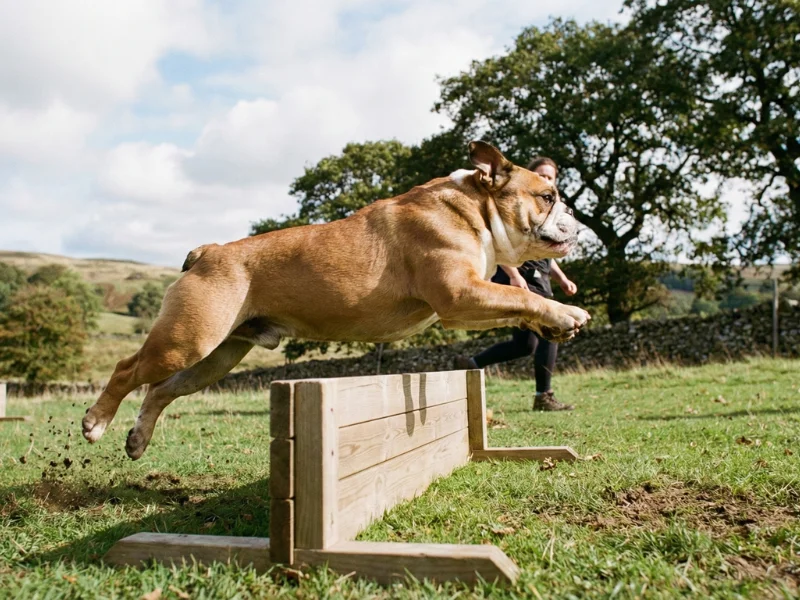
To be registered, a dog had to descend from two parents already on the books. From that moment on, every breed rested on a limited number of founders. Breeders drew from a restricted gene pool, generation after generation. The English Bulldog shows how this plays out. Researchers at the University of California, Davis, found that the entire breed descends from roughly 68 individuals. Every mating between relatives concentrates the genetic legacy of those first dogs a little further.
Yet mating related dogs goes back much further than any registry. Hunters, shepherds and working dog breeders already picked the best animals within their own packs. They kept the toughest male, the steadiest female, and bred them together. Their offspring were bred to each other in turn.
Nobody talked about genetics, but the principle was already there. Some 19th century authors even described when to use it and what could go wrong, with surprising accuracy. What registries added was traceability. For the first time, breeders could follow lines across several generations and actually measure things.
That written record is a major asset today. It allows modern registries like the FBKC to calculate reliable coefficients and give breeders solid information before every mating decision.
• Why Breeders Relied on It
Let's ask the question directly: why would anyone mate two related dogs on purpose? The answer comes down to one word, predictability. A breeder aiming for a specific type, coat, size or working ability wants consistent litters. Mating two dogs that share ancestors raises the odds that the puppies will look and behave like them.
The desired genes show up on both sides of the pedigree, and the litter becomes more uniform. In the 19th century, this method stabilized entire breeds within a few decades. The Setter, the Pointer and the Bulldog took their modern shape this way. Breeders of that era watched the results and adjusted, with no DNA tests at all. They locked in whatever worked.
If you are wondering how far a pedigree can predict a puppy, our article on predicting a puppy's looks and personality digs into exactly that.
There were practical and economic reasons too. A breeder who owned an outstanding stud dog preferred to use him on his own females rather than look elsewhere. Travel was expensive, transport was slow, and the pool of available dogs was local. Breeding within your own kennel kept things simple.
Breed clubs, meanwhile, rewarded the dogs that matched the standard most closely. Champions became highly sought after sires, and their bloodlines spread throughout the breed. Today we call this the popular sire effect. A single stud can father hundreds of puppies, and his descendants eventually end up mating with each other without anyone really planning it. Each individual choice looked sensible. The combined effect on a whole breed, however, was not visible yet.
• Inbreeding vs. Linebreeding: Know the Difference
Not all related matings carry the same weight. Breeders generally recognize three levels. Close inbreeding pairs very near relatives: father and daughter, mother and son, brother and sister. Linebreeding mates dogs that share a more distant common ancestor, often three or four generations back.
The goal is the same, to concentrate the qualities of a remarkable dog, but the risk drops considerably. Finally, outcrossing pairs two dogs with no close family connection at all. The FCI's scientific commission points out that matings between dogs from well separated lines do not raise the same concerns as breeding between close relatives.
The boundary between these categories stays blurry, and that is precisely why the coefficient of inbreeding was created.
In practice, many breeders describe their program as linebreeding when the common ancestors already appear in the second generation. The vocabulary sounds reassuring, but it says nothing about the real level of relatedness. A dog can show a pedigree with no repeated ancestor across four generations and still carry significant inbreeding inherited from founders much further back.
The opposite happens too. Only a measurable figure can settle the question. That is exactly what COI does, and the next section explains it in detail. It replaces impressions with a percentage, calculated from the pedigree or directly from DNA. With COI, linebreeding and close inbreeding stop being labels. They become points on the same scale, and every breeder can see precisely where a planned litter sits before making a decision.

COI: The Number That Puts Inbreeding on a Scale
Time for the numbers. Behind those three letters sits a century old calculation that registries and DNA labs still rely on today. Here is what it actually measures, how it is worked out from a pedigree, and why two different methods can give you two very different results for the same dog.
• Coefficient of Inbreeding, in Plain English
It all starts in 1922. American geneticist Sewall Wright publishes a formula to measure how closely related an individual's parents are. A century later, his coefficient is still the worldwide standard. The idea fits in one sentence. COI is the probability that a dog inherited two identical copies of the same gene from a single ancestor who appears on both sides of its pedigree.
It is expressed as a percentage, from 0 to 100. A few benchmarks help. A puppy born to a father and his daughter has a COI of 25%. Same for a brother and sister. Two first cousins produce 6.25%. A dog whose parents share no ancestor at all scores 0%. The higher the figure, the more the puppy's genes repeat themselves, and the less genetic diversity it carries.
So what does a COI of 10% mean in practice? On average, across 10% of its genome, the dog carries two strictly identical copies inherited from the same ancestor. Those regions leave no room for variation. If a harmful mutation sits there, it will be expressed, because no healthy version is available to compensate.
For scale, mixed breed dogs average a COI of around 5%. A 2021 study led by Danika Bannasch, covering 227 breeds, puts the average purebred dog at about 25%. In other words, the typical purebred is as inbred as a puppy from a full sibling mating. That number surprises a lot of owners. It does not condemn anyone, but it explains why inbreeding in dogs deserves real attention every time a litter is planned.
• How It's Calculated From a Pedigree
The calculation follows a clear logic. First, you identify every ancestor who appears on both the sire's side and the dam's side. For each one, you count the number of individuals on the path linking the two parents through that ancestor. You then apply Wright's formula, which halves the contribution with every generation crossed.
Finally, you add up the contributions of all common ancestors. One close ancestor weighs a lot, one distant ancestor weighs little, but dozens of distant ancestors add up fast. This is where pedigree depth changes everything. The Institute of Canine Biology ran the numbers on a single dog.
With 5 generations, its COI came out at 6%. With 10 generations, it rose to 10%. With 30 generations, it reached 25%. The dog never changed. Only the amount of information did.
This method rests on one big assumption. It treats the dogs at the far end of the known pedigree, the founders, as completely unrelated. In a breed built from a few dozen individuals, that assumption does not hold. Pedigree COI therefore almost always underestimates reality.
It remains very useful, as long as you compare calculations made at the same depth and from the same database. The UK Kennel Club displays a breed average next to every result and advises producing puppies at or below that level. At the FBKC, we follow the same approach. Our GenoLab tool lets you simulate a mating between two registered dogs and see the projected COI of the puppies before the litter even exists.
• Pedigree COI vs. Genetic COI: Which One to Trust
Over the past decade, a second method has taken hold. Labs such as Embark or MyDogDNA read the dog's DNA directly. They look for stretches where both copies of the genome are perfectly identical over long segments. Geneticists call these regions runs of homozygosity.
Their total length, measured against the whole genome, gives the genetic COI. The difference from the pedigree approach is fundamental. The pedigree calculation predicts a probability. The DNA analysis records a fact. It does not depend on pedigree depth, on a possible parentage error, or on the assumption that founders were unrelated.
As a result, genetic COI almost always comes out higher than a pedigree COI calculated over five or ten generations. A dog listed at 8% on paper can show 30% in DNA. Both figures are correct. They simply measure different things.
So which one should you trust? Both, but at different moments. Genetic COI is the most reliable way to know a dog that is already born. It helps you assess a breeding animal, verify a pedigree, and compare lines. Pedigree COI keeps one decisive advantage: it can be calculated in advance.
The puppies do not exist yet, so no DNA test is possible. Only the pedigree lets you anticipate the outcome of a mating. Good practice combines the two. Test your breeding dogs to learn their real level. Then simulate matings on the pedigree to pick the best combination.
One rule to remember: never compare a DNA figure with a pedigree figure, or two pedigree figures calculated at different depths. Each method has its own scale, and respecting that scale is what turns COI into a genuine decision making tool.

What Inbreeding Does to a Dog
A number stays abstract until you see its effects. So let's look at the evidence. Genetic studies, pet insurance records, long term cohort tracking: researchers can now measure exactly what a high COI changes in a dog's life. Disease, fertility, lifespan, and the thresholds worth remembering.
• Recessive Diseases: A Risk That Stacks Up
Let's start with the mechanism. Every dog carries two copies of each gene, one from the sire and one from the dam. Many inherited diseases are recessive: they only show up when both copies carry the mutation. A dog with a single faulty copy stays perfectly healthy.
It is a carrier, and it passes the mutation to half its puppies without anyone noticing. As long as breeding dogs are unrelated, the odds of pairing two faulty copies stay low. Breeding between relatives changes the picture. If a shared ancestor carried the mutation, it can arrive from both sides of the pedigree at once. Progressive retinal atrophy, von Willebrand disease and degenerative myelopathy all follow this exact pattern. COI measures precisely that probability of two copies meeting.
The link is direct. A COI of 25% means that, for any given gene, the dog has a one in four chance of carrying two copies from the same ancestor. If that ancestor passed on a recessive mutation, the disease risk jumps from very low to one in four. And this applies to every mutation present in the founders, not just one.
That is the real issue: mutations accumulate across generations. In a breed built from a few dozen dogs, each founder brought its own genetic flaws. Repeated matings between their descendants concentrated them.
DNA tests can now screen for known mutations, but they only cover a fraction of the genome. For all the others, the ones nobody has identified yet, a low COI remains the best protection available.
• Fertility, Immunity, Lifespan: Inbreeding Depression
Beyond named diseases, geneticists observe a broader effect they call inbreeding depression. It affects complex functions controlled by hundreds of genes: reproduction, immune defense, growth, stress resistance.
A study by Embark on 93 female Golden Retrievers from the Golden Retriever Lifetime Study put a number on it. For every 10% rise in genetic COI, the litter loses one puppy on average. The least inbred females produced around 8 puppies, the most inbred 6 or 7. Researchers also report lower male fertility, higher neonatal mortality and litters that are harder to achieve. No single disease explains it. The genome simply loses flexibility, and the dog copes less well as a result.
The immune system pays the most visible price. The genes that recognize pathogens work best when they are diverse. A highly homozygous dog has a narrower repertoire and responds less effectively to infections, allergies and autoimmune conditions. Lifespan follows.
A 2020 study led by Jessica Yordy confirmed a negative effect of inbreeding on longevity, even though body size remains the strongest single factor. In 2021, Danika Bannasch matched DNA data from nearly 50,000 dogs with the records of a Scandinavian pet insurer. The result: breeds with a COI above 25% generate 29% more non routine veterinary visits than mixed breed dogs.
If you want to understand the other factors that shape how long a dog lives, our article on dog lifespan walks through them one by one.
• COI Thresholds Every Owner Should Know
So at what number should you start worrying? There is no sharp line, but geneticists agree on several benchmarks. In conservation biology, a population whose average COI exceeds 10% triggers active monitoring. Many responsible breeding programs use that value as their reference.
Below 6.25%, the level of a first cousin mating, the risk stays moderate for a purebred dog. Between 6.25% and 12.5%, you enter a zone that calls for caution, especially if the line already has known health issues. At 12.5%, you reach the equivalent of mating two half siblings. At 25%, you reproduce the effect of a full sibling cross.
The Bannasch study shows that breeds sitting between 12.6% and 25% already generate 22% more veterinary care events.
These thresholds need careful reading. First, they apply to a specific calculation method. A pedigree COI of 5% over five generations can hide a genetic COI of 25%, as we saw earlier. Second, the individual number matters less than the trend. A mating at 8% in a breed averaging 4% deserves a second look.
The same 8% in a breed averaging 30% is real progress. That is why the UK Kennel Club recommends aiming for a COI at or below the breed average. Finally, some breeds defy the statistics. The Border Terrier and the Basenji show high COI and solid health, probably because harmful mutations were eliminated over time. COI remains a risk indicator, not a verdict. It guides decisions, it does not replace them.

Using COI to Make Better Breeding Choices
Understanding COI is good. Putting it to work is better. Whether you are looking for a puppy or planning your next litter, this number can guide real decisions. Here is how to read it on a pedigree, how to build it into a mating plan, and which tools exist today to help you.
• Checking a Dog's COI Before You Buy
You are visiting a kennel. The breeder shows you the parents, the pedigree, the health tests. This is the moment to ask one simple question: what is the COI of this litter? A serious breeder knows the answer. They give you the figure, the calculation method and the number of generations used.
They also give you the breed average, because a COI never stands alone. A puppy at 7% in a breed averaging 4% comes from a tighter mating than usual. The same 7% in a breed averaging 20% reflects real effort toward diversity. If the breeder does not know the COI of their puppies or brushes the question aside, you have just learned something valuable. It is not only about genetics. It tells you a lot about how they breed.
Three further signals deserve your attention. First, ask whether the parents have had a full DNA profile, not just the disease tests required in the breed. A genetic profile gives the sire's or dam's real COI, far more informative than a five generation calculation. Second, read the pedigree yourself.
If one name appears several times across four generations, especially a heavily used champion, the level of relatedness is probably high. Third, check the consistency between words and actions. A breeder who talks about genetic diversity but always pairs the same lines is sending a mixed message.
At the FBKC, every registered dog has a searchable pedigree with its COI calculated across the whole database. So you can verify things for yourself, before committing, without relying solely on the seller's word.
• Planning a Mating With COI in Mind
Now let's switch sides. You are a breeder planning a litter. The COI question comes before anything else, because it cannot be fixed once the puppies are born. The method is simple. You shortlist several studs that match your female in type, temperament and health results.
You then calculate the projected COI for each combination. Two dogs that are excellent individually can produce a highly inbred litter if they share the same ancestors. Conversely, a less decorated stud from a distant line can sometimes cut the COI by ten points. The goal is not to chase zero at any cost. It is to produce puppies whose COI is lower than their parents', or at least below the breed average. Every generation then becomes a chance to widen the gene pool rather than shrink it.
This approach takes some discipline, but it stays within reach. It often means looking further afield for a stud, sometimes abroad, and accepting a dog that is not the one everybody else is using. That is exactly where popular sires become a problem: every breeder who picks the same stud narrows the diversity of the whole breed a little more.
The breeders who get the best long term results are the ones who balance all the criteria: conformity to the standard, tested health, temperament and a controlled COI. None of these outranks the others.
If you are just starting out and want to build solid foundations before your first litter, our guide to becoming a dog breeder in Europe covers every step, from the paperwork to your first selection decisions.
• DNA Tests and Tools Available Today
The good news is that the tools have never been more accessible. On the DNA side, several labs now offer full genetic profiles. A single cheek swab is all it takes. The lab analyzes hundreds of thousands of markers spread across the entire genome and screens for several hundred known inherited conditions.
The genetic COI appears directly in the report, calculated from the dog's actual DNA rather than its pedigree.
Some labs go further and offer a litter simulation. You select two tested dogs, and the tool shows you the expected COI of the puppies along with the odds of clear, carrier or affected offspring for every condition screened. In Europe, several specialized labs also run the targeted tests specific to each breed, often required by clubs before a dog can be confirmed for breeding. Check with your breed club to find out which tests are recognized.
A full profile usually costs between 100 and 200 euros per dog. Set against the value of a litter, that investment is modest.
On the pedigree side, registries have built their own calculators. The UK Kennel Club offers Mate Select, which calculates the COI of a hypothetical mating between two registered dogs and shows it next to the breed average. Several European breed clubs provide comparable services.
At the FBKC, our GenoLab tool works the same way: you pick a male and a female from our database and get the projected COI of the puppies, calculated across the full available depth of the pedigree. The value of these tools lies in how they complement each other.
The DNA test tells you where your breeding dogs stand. The pedigree simulator tells you where the litter is heading. A breeder who uses both has all the information needed to decide with full knowledge. All that remains is to act on it, and to share the results with puppy buyers.

Breeds, Registries and the Future of Genetic Diversity
COI applies to every dog, but the question goes beyond the individual. Some entire breeds now find themselves at a genetic dead end. Clubs, registries and researchers are responding, sometimes under pressure from the courts. Here is a look at the breeds in trouble, the solutions underway, and what lies ahead for breeding.
• The Most Affected Breeds
Let's start with the extreme cases. The Norwegian Lundehund, a small puffin hunting dog, descends from a handful of survivors after two distemper outbreaks in the 20th century. Genetic analyses show it has lost nearly 39% of the diversity of its original population. Litters average just 2.8 puppies, and inherited digestive disorders affect almost every dog.
The Dalmatian illustrates another pattern. For decades, every Dalmatian in the world carried the mutation behind hyperuricosuria, a urinary condition. Selecting against it was impossible, since no clear dog existed within the breed. These two examples are not curiosities. They show what happens when a registry stays closed long enough with too few founders. Inbreeding in dogs then reaches a point where the breed can no longer fix itself.
Popular breeds are far from spared. The English Bulldog, built from roughly 68 founders, shows one of the highest genetic COIs ever measured by labs. The Cavalier King Charles Spaniel combines very low diversity with heart disease present in a large majority of older dogs.
The Pug, the French Bulldog and the Boxer regularly top morbidity rankings. The 2021 Bannasch study identifies FCI group 2, which gathers Molossers, Pinschers and Swiss Mountain Dogs, as the group generating the most veterinary care. By contrast, landrace breeds like the Hungarian Mudi or the Danish Swedish Farmdog keep low COIs, because their registries closed late or remain open.
The conclusion is clear: a breed's popularity does not protect its genetics. If anything, it exposes the breed to the popular sire effect.
• What Kennel Clubs and Registries Are Doing
Faced with these findings, institutions have started to move. The UK Kennel Club led the way in 2009. Since then, it has refused to register puppies from parent to offspring or full sibling matings. It also publishes the average COI for every breed and makes its Mate Select calculator available to all breeders.
The Norwegian Kennel Club went further. In 2014, it approved crossing the Lundehund with three related breeds: the Norwegian Buhund, the Icelandic Sheepdog and the Norrbottenspets. Every mating in the program is approved by the club, and the descendants rejoin the registry after several generations of backcrossing, once type and health have been verified. The Irish Kennel Club runs a similar project for the Irish Red and White Setter, and the Dutch Kennel Club for the Wetterhoun.
The Dalmatian case proves these programs work. In 1973, geneticist Robert Schaible crossed a Dalmatian with a Pointer, then bred the descendants back to Dalmatians for five generations. The result: dogs that meet the standard but no longer carry the mutation. After years of debate, the American Kennel Club eventually accepted these lines into its registry.
Meanwhile, outside pressure keeps growing. In Norway, a court case between 2022 and 2023 challenged the breeding of English Bulldogs and Cavalier King Charles Spaniels on animal welfare grounds. Dutch authorities have enforced strict conformation criteria for flat faced breeds since 2019.
The FCI, for its part, advises its members to monitor COI and avoid close matings. The movement is underway, and registries that refuse to evolve risk being overtaken by legislation.
• Toward More Sustainable Breeding
So what does the breeding of tomorrow look like? Geneticists agree on three directions. The first is making genetic COI standard for all breeding dogs. When every stud and every dam has a DNA profile, breeders plan their matings on real data, and registries can track each breed's diversity in real time.
The second direction involves managing the number of breeding animals. Capping the number of litters per stud and encouraging the use of lesser known males slows the loss of diversity, with no crossing to another breed at all. The third, and most debated, is the controlled opening of registries. For breeds whose gene pool has become too depleted, a supervised cross with a related breed is sometimes the only way out. The Norwegian and Dutch projects prove it can be done without losing type.
This thinking connects to a broader movement. Many modern crosses were created precisely to work around the dead ends of closed breeds, with results that vary depending on how rigorous the programs are.
If the topic interests you, our article on hybrid dogs explains what these breeds are really trying to fix.
At the FBKC, we chose to build a registry that records every dog's COI, makes it visible to buyers, and gives breeders the tools to bring it down. We do not believe purebred dogs and genetic diversity are at odds. Low COI breeds prove the opposite every day. The future of breeding belongs to breeders who measure, who share their data, and who are willing to look beyond the next litter. COI gives them the means to do it, and that is good news.
What to Remember About COI
Let's wrap up the investigation. Inbreeding has been part of dog breeding since its origins, and the closed registries of the 19th century made it unavoidable. For a long time, nobody could measure it. COI changed that. One number, from 0 to 100%, that says exactly how much of a dog's genome repeats itself.
Recent studies then established the link with health: smaller litters, weaker immunity, more veterinary care, shorter lives. The average purebred dog today sits at a COI of 25%, the equivalent of a full sibling cross. There is nothing hopeless about that finding. It gives a clear starting point to everyone who wants to do better, breeders and buyers alike.
The tools are here. DNA tests reveal the real COI of breeding dogs. Pedigree simulators project the COI of future puppies. The most advanced registries publish breed averages and restrict the closest matings. Only one thing is still missing: people actually using them. Before buying a puppy, ask for its COI and compare it to the breed average.
Before planning a litter, calculate it and aim to bring it down from one generation to the next. That is the spirit in which the FBKC displays COI on every pedigree and makes GenoLab available to its members. A breed's genetic diversity cannot be decreed. It is built, one litter at a time, by breeders who measure before they decide.
Frequently asked questions
COI, or coefficient of inbreeding, measures the probability that a dog inherited two identical copies of the same gene from an ancestor who appears on both sides of its pedigree. It is expressed as a percentage, from 0 to 100. The higher the number, the lower the dog's genetic diversity.
Geneticists recommend staying below 10% and, above all, below the breed average. A COI of 6.25% equals a first cousin mating, 12.5% a half sibling mating, and 25% a full sibling cross. The average purebred dog today sits at around 25%, so lower than average is already real progress.
A high COI raises the risk of recessive diseases and causes inbreeding depression: smaller litters, reduced fertility, weaker immunity and shorter lifespan. A 2021 study found that breeds with a COI above 25% generate 29% more veterinary care events than mixed breed dogs.
There are two methods. Pedigree COI is calculated from the family tree by identifying common ancestors across several generations. Genetic COI is measured by a DNA test that reads the genome directly. The genetic method is more accurate because it does not depend on pedigree depth.
DNA test your breeding dogs, simulate every mating before it happens, and aim for a COI lower than the parents'. Avoid studs already heavily used in the breed and look for a mate from a distant line, even abroad. A tool like GenoLab makes this planning simple.
Breeds mentioned in this article